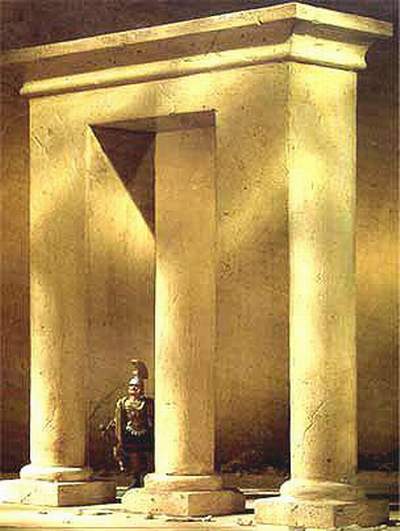
Are the pillars round or Square?
Category: General
Crime Don’t Pay…seriously, in China
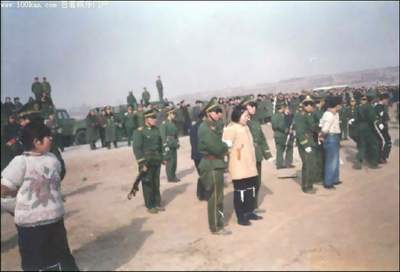
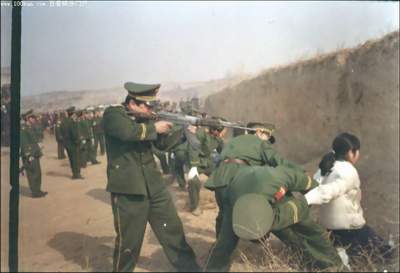
WARNING: THE NEXT TWO PICTURES MAY BE TOO EXPLICIT AND GORY FOR YOUR VIEWING. DO NOT PROCEED IF YOU CANNOT STAND IT. THANK YOU.
OOOH MY…You kill Spiderman!!!
Who could have kill Spiderman?

A. Doctor Octopus
B. Batman
C. Green Goblin
D. Ridsect (Insect Repllent)
of .. er.. boobies? blur boobies
June 11th, 2005 Posted by PeNNyPupZ

7 Responses to “of .. er.. boobies? blur boobies”
NSDS3HvLDjJdAMKhAJw wrote on 06/11/05 at 11:39 am :
stalk stalk
Leo Goh wrote on 06/11/05 at 12:54 pm :
oogle oogle …oogle-ing-ing
blur^sotong wrote on 06/11/05 at 1:21 pm :
hmm….tempting…
isit urs?
demonicsquid wrote on 06/11/05 at 1:21 pm :
hmm….tempting…
isit urs?
Slinky wrote on 06/11/05 at 8:01 pm :
hmm….tempting…
isit urs?
kimberlycun wrote on 06/12/05 at 7:17 pm :
when i was around ur age i was flat like airport. be happy babe, be very happy!
xes wrote on 06/12/05 at 9:43 pm :
arghhhhhhh my eyes my eyes!
gimmme antiseptic to wash my eyes!
argghghhhh!
Sorry LADIES for guys only….=P
Introducing Korea latest and hottest girl band…
LADY


Pretty or not…MORE PICTURES???
Hot~! Hot~!
Despite the rain, the weather has been extremly hot lately. I have not been able to sleep well for a few nights…ARGHHHHH
So you wanna hook up with Neptune
This is Neptune.
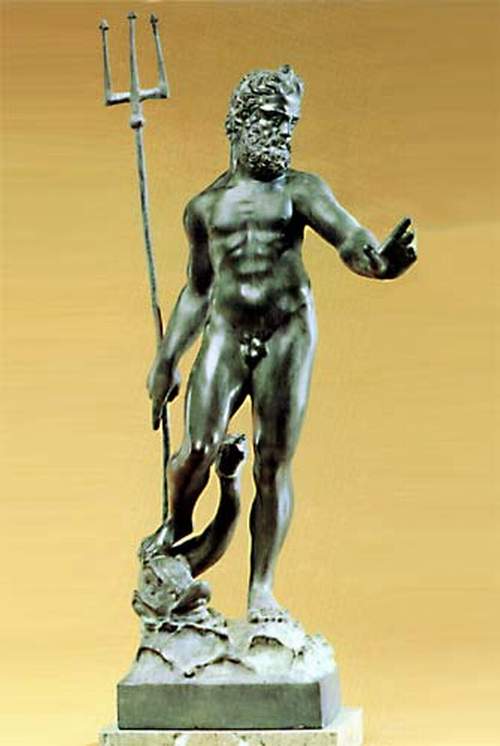
The Greek Sea God
What a perverted old man! Look, he doesn’t even has his pants on, letting his “asset” dangling out there like nobody’s business. Therefore, today, i am going to teach all of you how to fish this old man from the sea and bash him up.
Nanjing Massacre
During the last world cup, i was watching Japan playing against an European Team. I was cheering for the Jap. One of my English hallmate asked me a very interesting question.
“Whom did the Chinese (as in mainland China Chinese) fight during World War 2?”
“The Jap,” I answered.
“Why are you supporting their football team? They killed your forefathers and raped your women!”
Honestly, i don’t hate the Jap for what they did to the Chinese during World War 2 anymore. Maybe it’s because i am an oversea chinese. However, it still angered me when the Japanese Government and their history books denied the Nanjing Massacre even with all the evidence. Here is a story told by one of the Nanjing Massacre survivor, Madam Xia Shuqin :-
Nanjing massacre survivor tells of unspeakable horrors, fight for justice
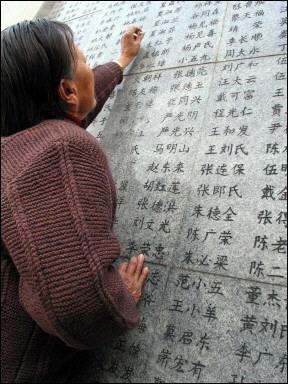
Madam Xia Shuqin looking for the name of her loved one who died during the Nanjing Massacre
NANJING, China (AFP) – Xia Shuqin has cried so many tears for her parents and siblings who were brutally murdered during the 1937 Japanese invasion of Nanjing that she says it has slowly made her blind.
It has been 67 years since that fateful day but Xia cannot forget how Japanese soldiers butchered her family, effectively marking the beginning of nearly two months of wholesale slaughter, rape and destruction that is today known as the Nanjing Massacre.
Stabbed three times and left for dead herself, Xia recalled in an AFP interview the terrifying moments of that smoke-filled morning of December 13, 1937, when Imperial troops first pounded on the door.
“It was my father who went to open the door and the Japanese soldiers, with guns already loaded, shot my father as soon as he opened up,” said Xia, a small, thin woman with an unseeing, greyishly discolored right eye.
Nine family members and four neighbours had been hiding at Xia’s home for weeks as Japanese bombs fell and fighting raged outside the ancient walls of this regal and once capital city of China, about 200 kilometres (124 miles) from Shanghai.
“People didnt dare to get out of their place and hid under tables for shelter,” said Xia, who is also partially blind in her other eye.
“Everything was in ruins and there was dust and smoke everywhere … the city was a complete mess.”
As the outgunned Chinese Nationalist army fled across the Yangtze River on that ignominious day, Nanjing fell to 50,000 Japanese troops who marched in, presenting themselves as benificent saviours.
They were anything but.
“My mom was embracing my one-year old sister under the table,” Xia continued.
“They dragged my mom out from under the table and immediately stabbed my sister to death. They just killed her like that,” she said, with a sharp wave of her arm.
On that harrowing day a dozen or so soldiers then set upon her mother, gang raping and then killing her, while two neighbourhood children cowering under the table with them were shot dead.
As the Japanese turned to dispatching others her grandparents grabbed Xia and her three remaining sisters and ran into another room, gaining precious minutes.
“I heard screams and gunshots from the other room but we were so scared we didn’t dare to make a sound,” said Xia.
Everything went quiet before the soldiers finally stormed in, bayoneting her grandparents first, then raping and killing her 15- and- 13-year-old sisters.
Xia blacked out.
She doesn’t know how long it was before she came to, but she remembers hearing the crying of her four-year old sister. Xia was soaked in blood, and had been stabbed three times in the arm and back.
Surrounded by the decomposing corpses of her family and neighbours, the two sisters hid in the house for the next 10 days, surviving on scraps of food.
“We didn’t dare to move or eat in daytime, Japanese soldiers were near by and they walked by my place on patrol everyday,” she said.
An old couple eventually found them and snuck them to the International Safety Zone, a makeshift refugee camp set up by foreigners who had remained in Nanjing to try and prevent further killings.
According to historians and thousands of recorded personal testimonies, what happened in Xia’s house occurred with abandon throughout the metropolis that was then home to one million residents.
By the time the Japanese army had finished their killing spree, according to conservative estimates 140,000 were dead, most of them unarmed civilians and many women and children.
Considered one of the bloodiest massacres in modern history, China estimates that some 300,000 were slaughtered. Many independent international counts put the death toll closer to 400,000.
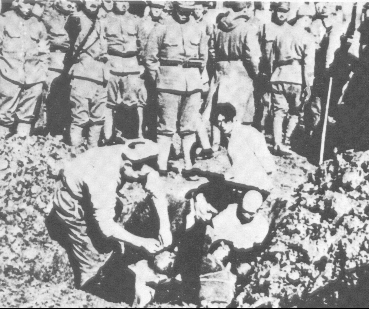
The Japanese burying the Chinese alive.
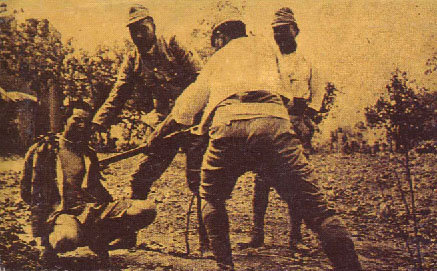
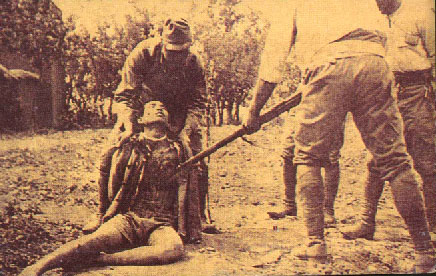
Brutally killed
Jing Shenghong, an expert on the subject at Nanjing Normal University, said the bloodbath was meant to “terrify Chinese people and the government into surrendering as soon as possible”.
It failed to work as China eventually expelled the Japanese.
Despite the overwhelming evidence, some of it from personal accounts of Imperial soldiers who took part in the massacre, history has not been able to bring closure to this horrific event.
Repeated denials by some Japanese academics and politicians that the Nanjing massacre was an orgy of murder has routinely enraged China in recent years, souring diplomatic relations.
Particularly galling for the dwindling number of survivors is Japan’s refusal to grant compensation, claiming that under international law individuals do not have a right to directly seek money from a warring nation.
In the most recent case, the Tokyo High Court in April refused compensation for 10 Chinese survivors or relatives of victims of the Nanjing Massacre and Japan’s Unit 731, which conducted germ experiments on humans in northern China.
“Under civil law, the country does not bear responsibility either,” ruled presiding judge Masahito Monguchi.
The issue of Japan’s World War II record has resurfaced with a vengeance this year, with three weeks of student-led protests throughout the mainland bringing Sino-Japanese relations to their lowest point in 30 years.
To blame in part are Japanese Prime Minister Junichiro Koizumi’s visits to the country’s wartime shrine, where class-A war criminals are buried, as well as Japan’s glossing over of its wartime record in school textbooks.
But it is also because Beijing has now started to prove itself more willing to challenge Japan as it has grown in economic power and political clout.
“Beginning from 1949 to the late 1970’s, China was caught up in all kinds of revolutionary political movements — the anti-rightist campaign, the Great Leap Forward, the Cultural Revolution,” said Wang Weixing, deputy director of the Institute of History Studies of Jiangsu Provincial Academy of Social Science.
“Research into the war and the massacre was neglected. But China’s reform in the 1980s not only liberated the economy, but also liberalized academic research.”
When it re-established diplomatic ties with Japan in 1972, China had agreed to drop claims for wartime reparations.
This stance continued in the 1980s when the Chinese government was reluctant to pressure Tokyo at time when it desperately needed investment as it began opening up to the world.
Official attitudes finally began to change in the 1990s amid a resurgence of nationalism among Japan’s right-wing party and a growing chorus of voices in South Korea and China for the island nation to apologise and compensate victims.
For Xia, books published by Higashinakano Osamu and Magsumura Goshio in the mid-1990s questioning the veracity of witnesses’ accounts of the events in Nanjing proved the final straw.
It prompted her in 2000 to sue for damages of 800,000 yuan (96,600 dollars) in a Beijing court. Her case has yet to be heard, but she says she will fight on as long as she can.
“I survived from the pile of dead bodies, how could I be a fake witness?” said an indignant Xia. “I just want to be healthy so I can sue them to the end.”
NOTE:
1. This article was originally published in Yahoo News
2. The photos are taken from Yahoo News and WWW Memorial Hall of the Victims in the Nanjing Massacre (1937-1938)
Yawn….
Lately, i have not been sleeping well cos the weather is too damn hot. I look a bit like this fish now :-

*yawn* I am so sleepy *yawn* Aiks! What are you looking at! Go away! *yawn*
Why smoking kills..
You want a f*cking cigaratte? (705kb)
WARNING: VIDEO NOT SUITABLE FOR CHILDREN OR THOSE EASILY DISTRUBED